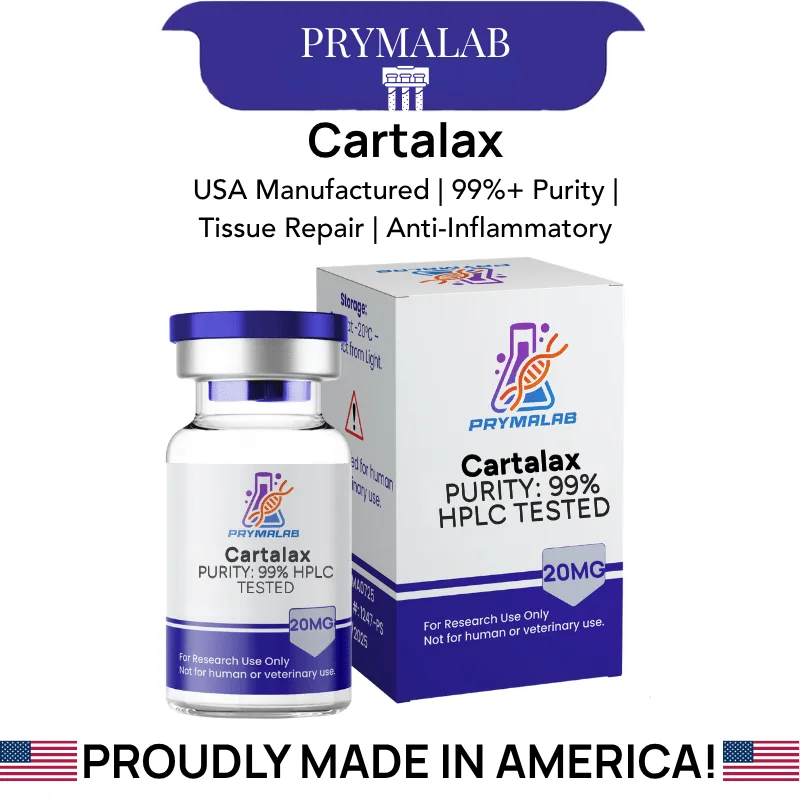
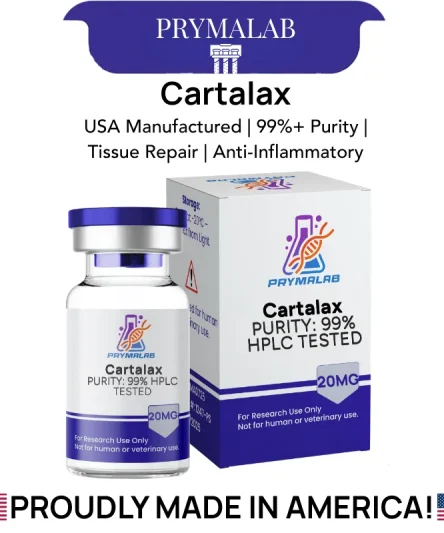
Cartalax peptide is a lyophilized vial of the tripeptide Ala-Glu-Asp, written AED, the cartilage-directed compound in the Khavinson bioregulator range. Its calculated mass of roughly 333.3 sits within a tenth of a dalton of Thymogen, which is an analytical hazard worth knowing about before ordering either.
Specification Table
Cartalax chemical and handling data
| Property |
Value |
| Compound |
Cartalax |
| Sequence designation |
AED |
| Amino acid sequence |
Alanine-Glutamate-Aspartate |
| Sequence provenance |
Secondary sources, converging. Not traced to a single primary citation. Confirm against the lot certificate before relying on it for calculation |
| Residue count |
3 |
| Molecular weight, calculated |
333.3 g/mol, computed from standard residue masses plus water rather than quoted from a paper |
| Near-isobaric relative |
Thymogen at approximately 333.4, roughly 0.04 Da heavier |
| Net charge at neutral pH |
Negative, two acidic residues against no basic residue |
| Oxidation-prone residues |
None |
| Chromophore |
None. Concentration cannot be determined by 280 nm absorbance |
| Compound class |
Short peptide bioregulator, cytogen subclass |
| Source tissue of the parent fraction |
Cartilage and connective tissue |
| Originating programme |
St Petersburg Institute of Bioregulation and Gerontology |
| Proposed mechanism in the literature |
Sequence-specific interaction with DNA, modulating tissue-associated gene expression |
| Mechanism status |
Hypothesis. Not independently established outside the originating programme |
| Receptor |
None identified |
| Appearance |
White lyophilized powder |
| Purity |
Per lot-specific certificate of analysis |
| Solubility |
Water soluble |
| Storage, lyophilized |
2-8°C or -20°C, protected from light and moisture |
| Regulatory status |
No approved human or veterinary formulation in any jurisdiction |
Why Does Cartalax Peptide Sit on Top of Thymogen by Mass?
Cartalax peptide and one relative calculate to within a rounding error of each other, and you can buy both. That is worth understanding before it causes a problem.
Cartalax is Ala-Glu-Asp, calculated at roughly 333.31. Thymogen is Glu-Trp, calculated at roughly 333.35, and the gap is about four hundredths of a dalton.
No bench instrument separates them. Even many high-resolution instruments would need care, because the difference sits in the second decimal place rather than the first.
The sequences share nothing. Cartalax is a three-residue peptide with no aromatic residue at all. Thymogen is a two-residue peptide that is half tryptophan.
That difference is what resolves the ambiguity instantly. Thymogen absorbs strongly at 280 nanometres and Cartalax does not absorb there at all, so a single ultraviolet reading distinguishes them in seconds.
Chromatography separates them easily too, since a tryptophan-containing dipeptide is far more hydrophobic than an all-polar tripeptide. The hazard lies specifically in treating nominal mass as sufficient proof of identity.
What Is a Cartalax Bioregulator Assigned To?
The Cartalax peptide organ naming follows the fractionation source rather than a demonstrated destination, and Cartalax is the clearest case of a non-organ assignment.
Most compounds here name a discrete organ: liver, heart, pancreas, prostate, thymus, lung. Cartalax names a tissue type instead, cartilage and connective tissue, which is distributed rather than localised.
That difference matters for the tissue-specificity claim. A peptide said to address the liver has one obvious destination. A peptide said to address cartilage has that tissue in every joint in the body.
The programme premise holds that short peptides from an organ extract carry regulatory information specific to that tissue. Applying it to a distributed tissue rather than a discrete organ stretches the idea further than the original framing did.
Whether that stretch is justified is exactly the sort of question a tissue-distribution study would settle, and no such study across this family appears in the published record.
Cartalax is also described in some sources as musculoskeletal rather than strictly cartilage, which widens the assignment again without adding evidence for it.
What Cartalax Peptide Benefits Have Been Measured?
The Cartalax peptide benefits phrasing is broader than the published endpoints, and separating the two is more useful than blurring them.
Work from the originating programme reports connective-tissue observations in aged rodent models, including histological assessment and markers of tissue-associated gene expression.
Cell-culture work in this family reports chromatin decondensation effects, which is the observation most often advanced in support of the DNA-binding hypothesis rather than of any specific tissue claim.
No well-powered independent Western clinical trial exists for Cartalax or for any other compound in the family. That absence is the defining feature of the whole literature.
Three things therefore need holding apart. The chemistry is settled, the research record is documented, and the mechanism is unresolved. A compound can be all three at once and every Khavinson bioregulator is.
Reading published claims against that split is the fastest way to tell a defensible statement from an inherited one.
What Cartalax Peptide Dosage Figures Are Published?
Everything below is an amount from a published study, in whichever species that study used.
Published rodent studies occupy the microgram per kilogram band by parenteral routes, which matches the wider Khavinson range and falls far below most of this catalogue.
The Russian clinical record sets out ten to twenty day courses at tens to low hundreds of micrograms, given as discrete blocks instead of open-ended exposure.
Sublingual and lingual preparations also appear in the family literature, which is a delivery route the injectable-focused secondary sources rarely mention and which carries its own amount conventions.
No receptor affinity is known, so no concentration can be justified from first principles and wide concentration ranging is a requirement rather than a refinement.
Cross-species conversion needs allometric scaling through body surface area rather than arithmetic on body weight.
What Should a Cartalax CoA Contain?
Cartalax peptide is the simplest analysis in this family, and the Thymogen coincidence makes one field non-negotiable.
Measured mass at high resolution, reported to two decimal places. A figure given as 333 is useless when a sibling compound sits at 333.35, and rounding hides exactly the digits that matter.
An ultraviolet scan, or a simple statement of absorbance at 280 nanometres. Cartalax should show essentially nothing there. Any meaningful signal means the vial contains something else, most plausibly Thymogen.
That single check costs a minute and resolves the ambiguity more decisively than mass does.
Sequence stated explicitly as Ala-Glu-Asp rather than by trade name, and counterion identity with net peptide content, and at 333.3 daltons a trifluoroacetate at 114 is over 25 percent of the associated mass.
Purity by reversed-phase chromatography with the method stated, since an all-polar tripeptide retains very poorly on a default peptide gradient.
How Does Cartalax Peptide Fit the Family Series?
Lining the sequences up makes the programme design visible in a way that reading them one at a time does not.
One series opens with alanine: Cartalax peptide is Ala-Glu-Asp, Cortagen adds proline, Cardiogen adds arginine, Bronchogen adds leucine, Epitalon adds glycine.
Cartalax is the parent of that whole group. It is the three-residue core the others extend, which makes it structurally the most interesting member rather than just the shortest.
A second series opens with lysine instead: Vesugen is Lys-Glu-Asp, then Livagen, Pancragen, Prostamax and Testagen each add a fourth residue.
Read together the two series make the central claim explicit. One residue, at one position, is supposed to determine which tissue a peptide addresses, and Cartalax is the control that has no fourth residue at all.
Running the alanine series side by side against Cartalax at matched molar concentrations would test that directly. No such comparison appears in the published record.
How Should the Vial Be Handled?
Cartalax peptide is chemically among the least demanding compounds in this catalogue.
There is no cysteine here, no methionine, no tryptophan and no asparagine-glycine motif, which leaves the routes that degrade most peptides simply unavailable.
Dry powder keeps sealed, dark and dry at 2 to 8 degrees Celsius or below, and ordinary refrigeration is enough for a compound this hard to damage.
Water solubility is good, helped by the two acidic residues. Run diluent gently down the vial wall and swirl once or twice rather than shaking.
In solution, hold at 2 to 8 degrees and divide before any freeze, though freeze-thaw tolerance is excellent here.
Record lot, measured mass to two decimal places, the 280 nanometre reading, counterion, net peptide content, diluent, volume, concentration and date.
A closing note on why the three-residue core matters analytically. Because Cartalax is the shortest member of the alanine series, every other compound in that series contains its full sequence.
A synthesis that stalls after three couplings therefore produces Cartalax rather than a truncated fragment, which means Cartalax is a plausible impurity in Cortagen, Cardiogen, Bronchogen and Epitalon preparations.
Asking whether a chromatogram for any of those four shows a peak at the Cartalax retention time is a specific and answerable quality question, and it is not one most buyers think to ask.
The same logic applies to Vesugen within the lysine series.
One further consequence of the shared core is worth spelling out for anyone comparing suppliers across the family.
A house that synthesises the whole alanine series from a common three-residue intermediate has a different impurity profile from one that builds each compound independently, and asking which approach was used tells you more about likely cross-contamination than a purity percentage does.
Neither approach is wrong. They just fail differently, and knowing which failure mode applies is worth a question.
Ask it once per supplier rather than once per order.
It takes thirty seconds and it changes how you read every certificate that supplier sends afterwards.
A final note on the sublingual route mentioned above. Because Cartalax appears in lingual as well as injectable preparations in the family literature, comparing an amount across the two without accounting for absorption differences is a category error.
Sublingual delivery bypasses first-pass metabolism but delivers a variable fraction, and the family literature rarely states which route a given figure came from.
Checking the route before borrowing a number is the same habit that the intranasal formats in this catalogue require, and for the same reason.
Published Literature
References verified against the publisher record. This literature originates almost entirely from one research programme.
- Khavinson VK, Malinin VV. Gerontological Aspects of Genome Peptide Regulation. Karger, Basel; 2005.
- Khavinson VK. Neuroendocrinology Letters. 2002;23(Suppl 3):11-144.
- Anisimov VN, Khavinson VK. Critical Reviews in Oncology/Hematology. 2010;74(1):46-66.
- Fedoreyeva LI, Kireev II, Khavinson VK, Vanyushin BF. Biochemistry (Moscow). 2011;76(11):1210-1219.
- Khavinson VK, Solovyov AY, Zhilinsky DV, Shataeva LK, Bandaletova TY. Bulletin of Experimental Biology and Medicine. 2012;153(4):500-505.
Frequently Asked Questions
What is Cartalax peptide?
A lyophilized vial of the tripeptide Ala-Glu-Asp, written AED, the cartilage-directed compound in the Khavinson bioregulator range. Supplied for laboratory research alone, and approved nowhere for any use.
Why does its mass sit on top of Thymogen?
Coincidence of residue arithmetic. Cartalax calculates to roughly 333.31 and Thymogen to roughly 333.35, a gap of about four hundredths of a dalton, despite sharing nothing in sequence.
Can a mass spectrometer separate them?
No bench instrument can, and even many high-resolution instruments would need care, because the difference sits in the second decimal place rather than the first.
What distinguishes them instantly?
Ultraviolet absorbance. Thymogen is half tryptophan and absorbs strongly at 280 nanometres. Cartalax has no aromatic residue and does not absorb there at all, so one reading settles it in seconds.
Why is the tissue assignment unusual?
Because cartilage is a distributed tissue rather than a discrete organ, and most compounds here name liver, heart, pancreas or thymus. A peptide addressing cartilage has that tissue in every joint in the body.
Does that stretch the programme premise?
It does. The premise holds that short peptides from an organ extract carry information specific to that tissue, and applying it to a distributed tissue widens the idea beyond its original framing.
What endpoints have been measured?
Connective-tissue observations in aged rodent models including histology and gene-expression markers, plus cell-culture work reporting chromatin decondensation, which supports the DNA-binding hypothesis rather than any tissue claim.
What dosage figures are published?
Published rodent studies occupy the microgram per kilogram band by parenteral routes, with a Russian clinical record setting out ten to twenty day blocks at tens to low hundreds of micrograms.
Are other delivery routes described?
Yes. Sublingual and lingual preparations appear in the family literature, a route the injectable-focused secondary sources rarely mention and which carries its own amount conventions.
What must the certificate show?
Measured mass at high resolution reported to two decimal places, plus a 280 nanometre reading. A mass given as 333 is useless when a sibling sits at 333.35, and rounding hides the digits that matter.
How large is the counterion correction?
At 333.3 daltons a single trifluoroacetate at 114 is over 25 percent of the associated mass, among the largest corrections in this catalogue. Calculate from net peptide content, not the vial label.
Compliance Statement
Cartalax peptide is sold exclusively for laboratory research use. It is not a drug, food, or cosmetic product, and it is not a dietary product of any kind. It is not approved by the FDA or any comparable authority for human or veterinary use, its proposed mechanism has not been independently established, and amounts cited are figures from published studies in the species those studies used. This product is not intended to diagnose, treat, cure, or prevent any disease. It must not be given to humans or animals. Purchase is restricted to qualified researchers and institutions operating within applicable laws. All handling is the responsibility of the purchasing laboratory.









19 reviews for Cartalax 20mg Peptide